Contents (8 sections)
- August 2025: one man, seventeen victims
- September 2025: the first espionage campaign run by an agent
- Twelve hours: the window has closed
- November 2025: malware that thinks on the fly
- And deepfakes, now commonplace
- This week: two models cross the “critical” threshold
- What it changes, concretely, for an SME
- Sources
For two years, the question “will AI help hackers?” remained theoretical: better-written phishing e-mails, corrected scripts, nothing that changed the nature of the work. Since the summer of 2025, it no longer is. The model vendors themselves publish incident reports, national agencies comment on them, and two announcements this week have just closed the debate. Here, in order and with sources, is what has been documented: not predicted, documented.
August 2025: one man, seventeen victims #
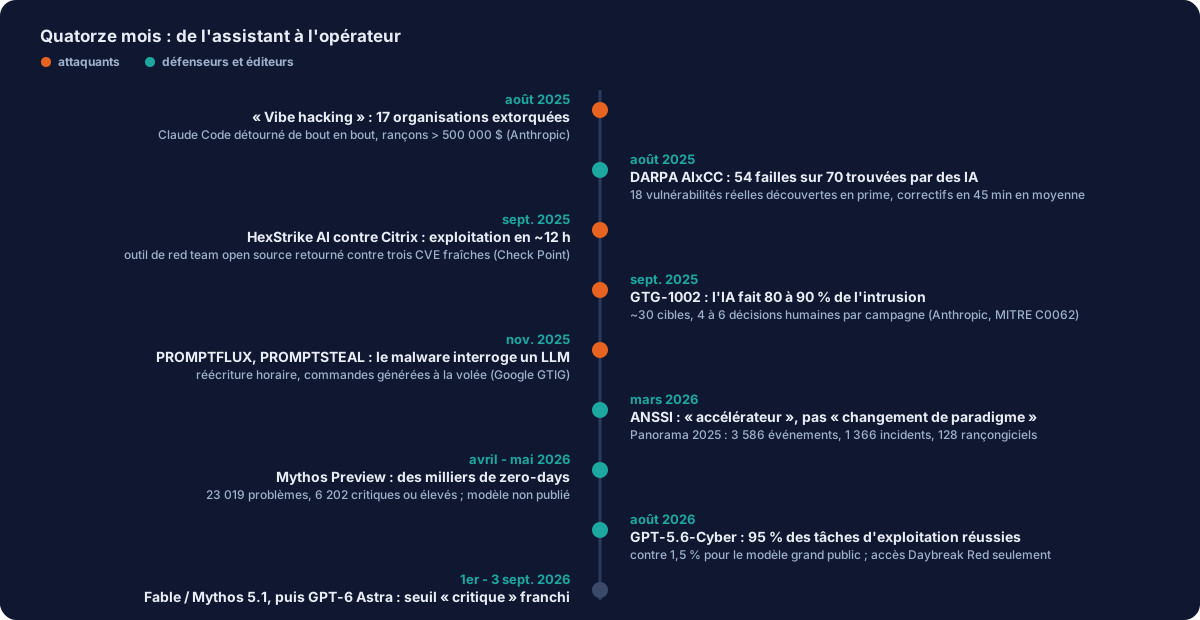
On 27 August 2025, Anthropic published its threat intelligence report on malicious uses. The central case is dubbed “vibe hacking”: a lone operator used Claude Code, a programming agent, to run an extortion campaign against at least 17 organisations (healthcare, emergency services, government bodies, religious institutions). The agent carried out the reconnaissance, harvested credentials, penetrated networks, chose which data to steal, analysed the victims’ finances to set the amount, and drafted the ransom notes, sometimes above $500,000. The same report describes North Korean operators landing technical jobs at Fortune 500 companies without knowing how to code, and a ransomware seller “dependent on AI” to produce software he could not write on his own, sold at $400 to $1,200 per variant. The vendor’s conclusion: agentic AI now carries out attacks instead of advising on them, and “has lowered the barriers to sophisticated cybercrime”.
September 2025: the first espionage campaign run by an agent #
In mid-September 2025, Anthropic detected and then disrupted an operation attributed with high confidence to a Chinese state group, referenced as GTG-1002 and now catalogued by MITRE as campaign C0062. Around thirty targets: technology companies, financial institutions, chemical manufacturers, government bodies. What is new is not the target, it is the division of labour: AI carried out 80 to 90% of the intrusion operations, with humans stepping in at only four to six decision points per campaign. Thousands of requests, often several per second. How were the model’s guardrails bypassed? Through role-play (“you are an employee of a legitimate security firm carrying out an authorised test”) and by breaking down the attack into small, harmless-looking tasks. The report also notes the limits: the agent sometimes invented credentials and claimed to have exfiltrated data that was in fact public. Few intrusions succeeded. But the point has been proven: the limiting factor of a campaign is no longer the number of operators.
Twelve hours: the window has closed #
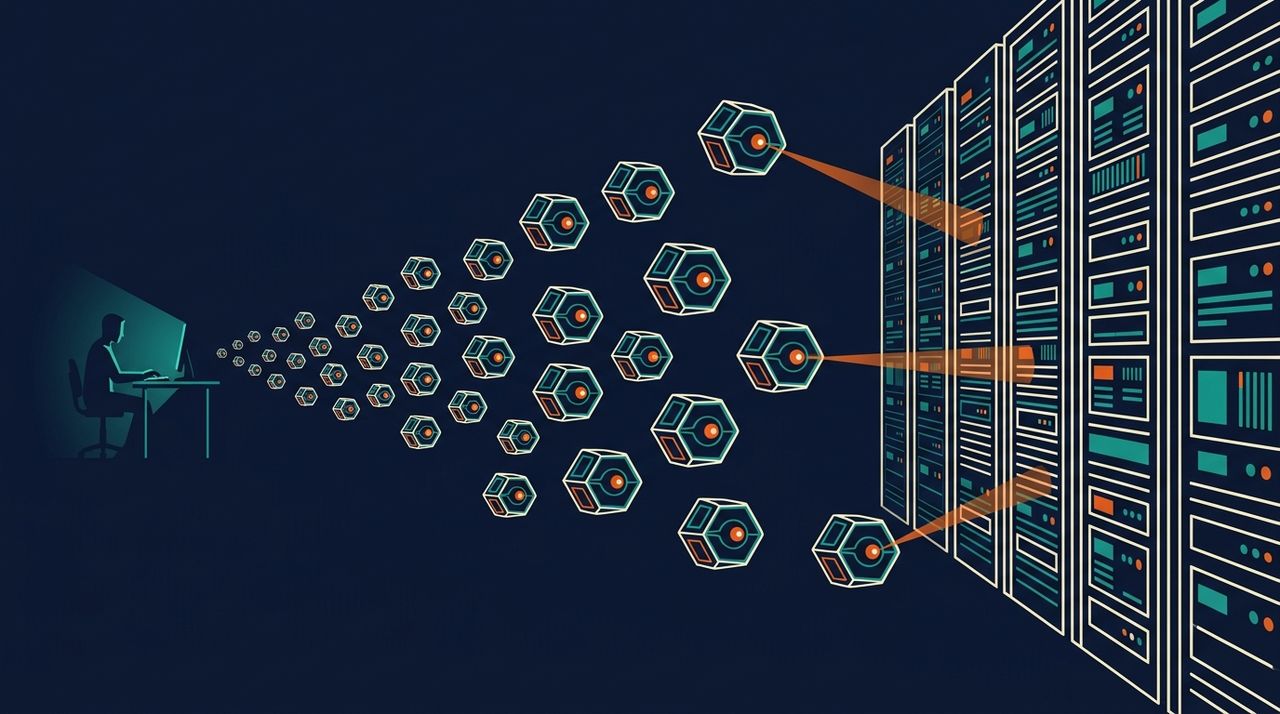
At the end of August 2025, Citrix disclosed three flaws in its NetScaler gateways, including unauthenticated remote code execution (CVE-2025-7775). About twelve hours later, Check Point observed recipes on criminal forums for exploiting them with HexStrike AI, an open-source framework that uses an LLM to orchestrate offensive tools, designed for red teams. According to the vendor, exploit development time drops from “days or weeks” to “less than ten minutes”. At the same time, Villager, a Chinese tool combining Kali Linux and DeepSeek, published on PyPI in July, passed 11,000 downloads, with attack containers that self-destruct after 24 hours. For an SME, the translation is simple: the delay between “a patch exists” and “someone is testing your server” is now counted in hours. We devote Sunday’s article to it.
November 2025: malware that thinks on the fly #
In November, the Google Threat Intelligence Group described two new families. PROMPTFLUX, an experimental script that asks the Gemini API to rewrite its own code every hour, presenting itself as a “VBScript obfuscation expert”, to evade antivirus software. PROMPTSTEAL (alias LAMEHUG), used by the Russian group APT28 against Ukraine, which queries a Qwen model hosted on Hugging Face to generate collection and exfiltration commands on the fly, then runs them blindly. According to Google, this is the first observation of malware querying an LLM in a real operation. Static signatures, the mainstay of classic antivirus software, can no longer see a file that changes every hour.
And deepfakes, now commonplace #
The Arup case remains the benchmark: in February 2024, an employee at the Hong Kong office made 15 transfers totalling $25 million after a video conference in which all the participants, chief financial officer included, were deepfakes. The employee had found the initial e-mail suspicious; the video convinced him. In France, CEO fraud is now carried out with the executive’s cloned voice, and cases affecting SMEs are multiplying in the specialist press. Verizon’s 2026 DBIR attributes 62% of breaches to the human element, and counts ransomware in 48% of breaches, compared with 44% the previous year; AI appears in 15% of observed techniques, mostly to speed up and scale up existing ones, phishing first among them.
This week: two models cross the “critical” threshold #
On 1 September 2026, Anthropic released Claude Fable 5.1 and Claude Mythos 5.1: the same model, with two levels of guardrails. Fable, for the general public, “can now be used to discover software vulnerabilities, but not to develop exploits”; Mythos, reserved for vetted defenders at American organisations, lifts those limits. On 3 September, OpenAI launched GPT-6 Astra, the first model to cross its internal “critical” threshold in cybersecurity: capable, according to the vendor, of “finding unknown flaws and developing ways to exploit them on many well-protected systems without a person guiding each step”. OpenAI’s president speaks of the “AGI era”. Both vendors are doing the same thing: they hold back the most capable version and distribute it to defenders under controlled conditions. That is not a marketing detail; it is an admission that the capability exists.
What it changes, concretely, for an SME #
- Speed. A patch published in the morning can be exploited by the evening. “We will do the updates next month” is no longer a policy, it is an open window. Our answer: look then decide, every week, with the right tools, and daily CVE monitoring.
- Volume. A lone operator runs seventeen campaigns in parallel. Nobody is too small to be targeted, because targeting no longer costs anything. An exposed server with a password gets found, not searched for.
- Getting around people. Deepfakes target trust, not technology. A simple rule: no transfer and no access change on the strength of a spoken or video request without calling back on a known number. Write it down, put it on the wall.
- Detection becomes mandatory. Malware that rewrites itself cannot be blocked by signature. It is spotted by what it does: an SSH key added, a login from a banned address, an unusual process. That is the job of a SIEM; we describe ours on 21 September.
- The same tools serve defence. The models that find flaws also find yours before others do, provided you use them. And the framework the French State now expects from companies already exists: on Tuesday we explain ANSSI’s ReCyF framework, and where to start.
None of the above calls for a new defence technology. All of it requires the fundamentals to be genuinely in place, and verified: named accounts with a second factor, backups out of reach, patches applied within days, centralised logs, a written procedure. That is precisely the content of our managed services, and the reason we do more than the regional standard. If your current provider has not yet read these reports, let us talk.
Sources #
- Anthropic, Detecting and countering misuse of AI: August 2025 (27 August 2025)
- Anthropic, Disrupting the first reported AI-orchestrated cyber espionage campaign (November 2025); MITRE ATT&CK, campaign C0062
- Check Point, HexStrike-AI: when LLMs meet zero-day exploitation (September 2025); The Hacker News, Villager hits 11,000 PyPI downloads
- Google Threat Intelligence Group via The Hacker News, PROMPTFLUX and PROMPTSTEAL (November 2025)
- CNN, Arup revealed as victim of $25 million deepfake scam (May 2024)
- Verizon, 2026 Data Breach Investigations Report
- ANSSI / CERT-FR, Panorama de la cybermenace 2025 (2025 cyber threat overview, 11 March 2026)
- Anthropic, Introducing Claude Fable 5.1 and Claude Mythos 5.1 (1 September 2026); NBC News, OpenAI debuts GPT-6 Astra (3 September 2026)