Contents (25 sections)
- Where does French e-invoicing stand in November 2026?
- Approved platform, compatible software, directory: who does what?
- The approved platform (formerly PDP)
- Compatible software: your own tool
- The e-invoicing directory and the concentrator: what is left of the public portal
- How to choose an approved platform: an SME checklist
- One SME, three starting points
- You invoice in off-the-shelf software
- You invoice in a spreadsheet or a word processor
- You have an in-house tool, an ERP or business software
- What has gone wrong since 1 September, and what the DGFiP provides
- The directory cannot find your customer's platform
- E-invoice status: rejected or refused, two cases not to confuse
- The PDF sent "as well", and duplicates
- The platform stops responding
- Invoices arrive, but not in your tool
- Connecting your tool to its approved platform before September 2027
- Frequently asked questions about approved platforms
- Is an approved platform mandatory for an SME?
- Is there a free approved platform?
- Can you switch approved platform, or use several?
- Where is the official list of approved platforms?
- Do you need to change software for e-invoicing?
- Key takeaways
- Sources
On 3 November, the French National Assembly adopted an amendment suspending mandatory e-invoicing, with no time limit, for SMEs and farmers. The next evening, it rejected the whole revenue part of the 2027 budget, by 458 votes to 0, and the amendment fell with it. The bill goes to the Senate in the government's version: for now, the obligation for SMEs to issue electronic invoices stays set for 1 September 2027. The obligation to receive them has applied since 1 September 2026: a company without an approved platform faces formal notice, then a fine.
Receiving and issuing both go through an approved platform (plateforme agréée). As of 4 November, the official list counts 158 that have met all the conditions. Here is how to choose yours, and how to handle the most common blocking points, based on official texts and the start-up guide of the French tax authority (DGFiP). One disclosure, so you can read on with the full picture: Sanfytech is not an approved platform. We write custom software, and we connect it to whichever platform our clients choose. We have nothing to sell you in this choice.
Where does French e-invoicing stand in November 2026? #
The timeline has not moved: large and mid-sized companies have been issuing since 1 September 2026, SMEs, small businesses and micro-enterprises will issue from 1 September 2027, and reporting data to the tax authority, known as e-reporting, follows the same pace.
To support the start-up, the DGFiP published a practical guide of 29 questions, such as "What if my invoice is rejected by my platform or by the recipient's?" or "What if the buyer refuses my invoice?". Its line is clear: no penalties applied "immediately, automatically and blindly" to a company whose difficulty is "real, documented and followed by corrective action". The same guide states that this approach is "neither a postponement nor a suspension of the obligation". The common thread of the 29 answers fits in one instruction: keep a record of every step.
The available figures show that many companies are not ready. In April, the barometer of the French Order of Chartered Accountants found 38% of companies not yet ready; only 35% had chosen their approved platform, and 40% did not know any. In September, an Ipsos BVA poll for Kolecto of 503 SME managers, reported by AFP, drew a rather reassuring first picture, with some sore points: 34% had dealt with a customer or supplier who was not ready, 21% with bugs, 21% with difficulties with their platform.
Approved platform, compatible software, directory: who does what? #
The approved platform (formerly PDP) #
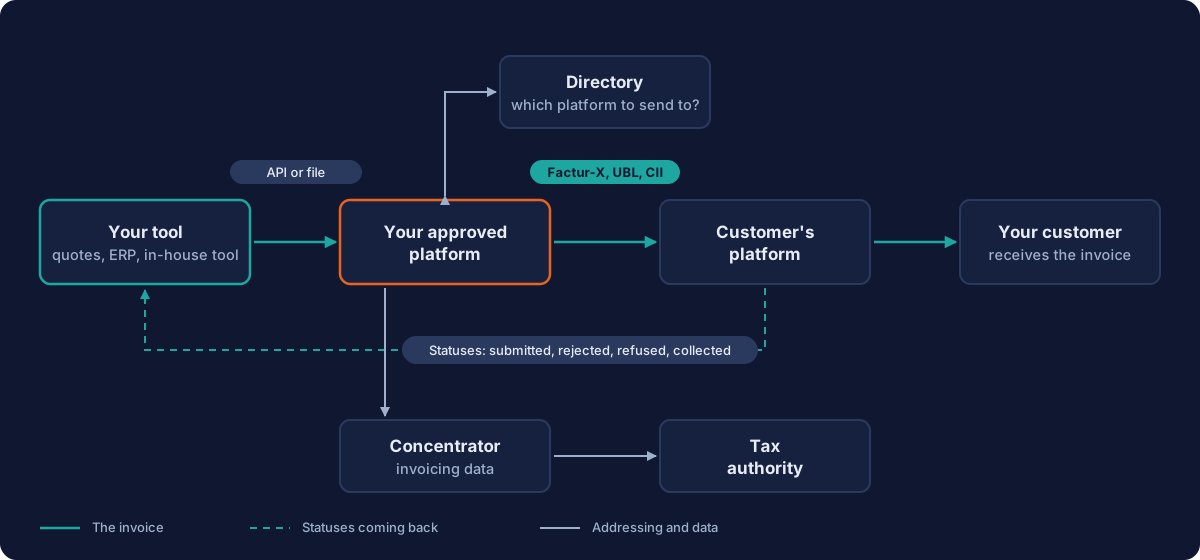
An approved platform, formerly called a partner dematerialisation platform (PDP), is an operator that has been registered by the tax administration for a renewable period of three years. It issues, transmits and receives your invoices, extracts the data the tax authority needs and transmits transaction and payment data. Its registration only becomes final once it has passed interoperability tests in real conditions: this is why the official list separates operators that have passed everything from those still waiting for these tests.
The choice is free. The DGFiP's FAQ says so in plain words: a company may choose one or more platforms, and switch "at any time". It may even use one for issuing, another for receiving and a third for e-reporting.
Compatible software: your own tool #
Your invoicing software, your management software or your in-house tool does not need to become an approved platform. It prepares your invoices; for them to go out, it must be connected to at least one approved platform. This is called "compatible software" (solution compatible). The administration created two separate logos, "approved platform" and "compatible solution": a vendor showing the second tells you its software connects to a platform, not that it is one.
The e-invoicing directory and the concentrator: what is left of the public portal #
The original plan included a public portal that was to offer a free minimum service. On 15 October 2024, the State refocused it on two functions: a directory of recipients and a data concentrator. The DGFiP explains this choice by the wish to avoid concentrating technical risk on a single point of passage and to limit costs for public finances. The direct consequence: the State will not provide a free platform.
The directory is the piece everyone discovered in September. It tells the sender which platform to send each customer's invoice to. Your company is registered in it by your receiving platform, after your formal agreement: until that is done, your suppliers do not know where to send you their invoices.
How to choose an approved platform: an SME checklist #
The administration does not publish a selection grid. It only says that companies should choose a platform according to their needs, their activity and the volume of invoices exchanged. Here are the questions we recommend asking before signing, in the order in which they save time.
- Its status on the official list. Check on impots.gouv.fr that it appears among the operators that have met all the conditions, interoperability tests included, and not only among those still waiting for them.
- The connection to your tool. A documented API, a test environment, file upload or manual entry: this point decides your monthly workload.
- Formats. Every platform must offer the core formats Factur-X, UBL and CII. Check that it accepts the format your tool produces, and that it can give you a readable version of the invoices you receive.
- Lifecycle statuses. Four are mandatory: submitted, rejected, refused and collected, the last one only for services on which VAT is due on collection. Ask which ones come back into your tool, and how.
- E-reporting. If you sell to consumers, or buy or sell abroad, these transactions do not go through electronic invoices, but their data must still reach the tax authority. The platform must handle it.
- Access for your accountant. Can they see your invoices and their statuses without re-keying anything?
- Security and hosting. Platforms are subject to strict requirements, including ISO 27001 and hosting data within the European Union. Ask where your invoices are.
- Reversibility. How do you get your history back, and what happens to your directory address if you leave?
- The real price. What is included: volumes, API access, archiving, export. On 1 August 2026, the DGFiP reported that more than ten platforms offered free or no-extra-cost services; read their limits before relying on them.
- Support. Who answers when an invoice is rejected on a Friday evening, and how fast?
One SME, three starting points #
You invoice in off-the-shelf software #
This is the simplest case. Ask your vendor whether it is an approved platform itself, or compatible software connected to a platform, and which one. In the second case, that platform will often be the easiest choice for you, but nothing obliges you to take it.
You invoice in a spreadsheet or a word processor #
A plain PDF sent by email is not an electronic invoice: the DGFiP's FAQ says so plainly. You will need a tool that produces a structured format, either the input portal of an approved platform or invoicing software. For a few invoices a month, entering them on the platform may be enough; beyond that, re-keying quickly becomes the main source of errors.
You have an in-house tool, an ERP or business software #
This is the situation we see most often, and it is rarely the whole software that is missing: it is the connection. Your quotes, delivery notes and invoices are already created in a tool that knows your rules; it needs to produce a compliant file, send it to the platform through its API, then retrieve the statuses and your suppliers' invoices. Whether that tool is a custom ERP, a business application that chains quotes and invoices or a program written ten years ago, the question is the same. If you are unsure whether to keep it, our guide explains what custom software is and when it is worth it.
What has gone wrong since 1 September, and what the DGFiP provides #
The directory cannot find your customer's platform #
If your customer has not chosen a platform yet, its address is not in the directory: your platform tells you it cannot deliver the invoice. The DGFiP's FAQ covers this case: exceptionally, the invoice may then be sent by email or post, with no consequence on the debt being due or on payment. If the customer is registered, the guide asks you to first check the details used (SIREN, SIRET, receiving establishment), then to see with your platform whether the data is wrong or the routing failed, and to keep a record of the steps taken.
E-invoice status: rejected or refused, two cases not to confuse #
A rejection comes from a platform. It is a technical incident: wrong format, missing mandatory data, a party wrongly identified, routing impossible. You correct the invoice and send it again through the electronic channel. A refusal comes from the buyer. It is a lifecycle status, always justified, reserved for the grounds set by the standard (non-compliance the receiving platform did not detect, wrongly addressed invoice, contractual conditions that prevent it from being processed), and it must not be used for a mere commercial dispute. If the refusal is justified and the invoice must be issued again, the new invoice gets a new number. If it is not, the guide recommends not creating a credit note automatically: you handle the disagreement, and you document it.
The PDF sent "as well", and duplicates #
Out of habit, many companies send the invoice through the platform and by email. The DGFiP's guide advises against it: a duplicate should be kept for cases where it helps continuity, and statuses should be used to check whether it is really needed. The risk is real: the same invoice paid, booked or declared twice.
The platform stops responding #
A platform outage, yours or your customer's, must not stop your business. The guide asks you to keep evidence of it (error message, support ticket, timestamp), allows you to bring the invoice to the customer's attention through another channel, then requires you to send it electronically as soon as the incident is resolved, without turning it into a second invoice.
Invoices arrive, but not in your tool #
We see this case often among our clients: the receiving platform is appointed, but invoices stay there; someone has to fetch them, re-key them, then match them with orders. The guide accepts temporary internal arrangements, provided the difficulties and the steps taken are recorded. It is an acceptable patch for the autumn, not for the year ahead.
Connecting your tool to its approved platform before September 2027 #
For an SME, the ten months left are enough, provided they are broken down. First, produce a valid file from your tool, in one of the core formats. Then send it to the platform through its API and retrieve the statuses in return, so that your team sees in its own tool that an invoice was rejected or collected. Finally, bring your suppliers' invoices into the same tool, matched with your orders.
The DGFiP's guide allows you to start now: a company not yet required to issue may do so voluntarily, step by step (some customers, some establishments), and go back to its usual methods temporarily if the trial fails. It is the best way to reach September 2027 with a process already run in. It is our job: connecting your tool to your approved platform, without changing what works.
Frequently asked questions about approved platforms #
Is an approved platform mandatory for an SME? #
Yes, for receiving, since 1 September 2026. A company that has not appointed one first receives formal notice to comply within three months. If nothing changes, the fine is 500 euros, then 1,000 euros for each new three-month period (article 1737 of the French General Tax Code). For issuing, the obligation for SMEs starts on 1 September 2027; from then on, each invoice not issued electronically incurs a fine of 50 euros, up to 15,000 euros a year.
Is there a free approved platform? #
The State does not offer one. According to the DGFiP, more than ten private platforms offered free or no-extra-cost services on 1 August 2026; they are sometimes limited in volume or features. Before choosing, check what is included: API access, archiving, history export, support.
Can you switch approved platform, or use several? #
Yes to both. A company may use different platforms for issuing, receiving and e-reporting, and switch platform at any time. Before leaving, make sure you get your history back and that your directory address is updated.
Where is the official list of approved platforms? #
On impots.gouv.fr, as two downloadable lists: the operators that have met all the conditions, and those still waiting for interoperability tests. It is updated regularly: as of this article, the page was last modified on 3 November 2026 and the file is dated 4 November.
Do you need to change software for e-invoicing? #
Not necessarily. If your current tool knows your rules and your customers, it is often simpler to add the connection to a platform than to start again elsewhere. If you are still considering a new tool, our guide explains how much custom software costs.
Key takeaways #
The moratorium amendment adopted on 3 November did not survive the rejection of the budget the next day: for now, the September 2027 deadline stands, and receiving has been mandatory since last September. Choosing an approved platform is not about price alone: the connection to your tool, the statuses that come back to you and the ability to leave matter just as much. Early feedback mostly points to customers and suppliers who are not ready yet; for the directory, rejections, refusals and outages, the DGFiP's guide already sets out what to do.
At Sanfytech, we do not sell a platform. We write custom software in Strasbourg, host it in France, and connect our clients' tools to the platform they have chosen, so that an invoice leaves from where it is created and its statuses come back there.
Does your invoicing tool need to move to electronic invoices, or are you torn between keeping it and replacing it? Let's talk: in a free first conversation, we look at whether a platform alone is enough in your case, or whether your tool needs connecting.
Sources #
- French tax authority (DGFiP), e-invoicing start-up guide as of 1 September 2026 (July 2026), in French: the 29 questions, sheets 2, 10 to 13, 17 to 19 and 29.
- DGFiP, FAQ "Je découvre la facturation électronique" (1 September 2026) and FAQ "Tout savoir" (August 2026), in French: timeline, choosing and switching platforms, customers without a platform, free offers.
- impots.gouv.fr, e-invoicing and approved platforms and list of approved platforms, in French (updated on 3 November 2026; 158 operators in the 4 November file).
- French Ministry of the Economy, press release of 15 October 2024, in French: refocusing of the public portal on the directory and the concentrator.
- Légifrance, article 1737 of the French General Tax Code, in French: penalties.
- AIFE, external specifications v3.2 (30 April 2026): core formats Factur-X, UBL and CII, mandatory lifecycle statuses.
- LCP, rejection of the revenue part of the 2027 budget (4 November 2026); LégiFiscal, vote on the moratorium amendment (4 November 2026), in French.
- French Order of Chartered Accountants, OpinionWay and ECMA barometer (28 April 2026); Ipsos BVA poll for Kolecto reported by AFP, MoneyVox (1 October 2026), in French.