Contents (16 sections)
- What TMA means
- What does it cover? The types of maintenance
- Maintenance, managed hosting, warranty, MCO: what is the difference?
- What an application maintenance contract should contain
- Fixed price, tickets or time and materials: how it is billed
- Taking over software written by someone else: the handover phase
- Choosing a maintenance provider: ten questions to ask
- When maintenance is no longer enough
- Frequently asked questions about application maintenance
- What is the difference between application maintenance and managed hosting?
- Is a maintenance contract mandatory?
- Can you change maintenance provider?
- How much does application maintenance cost?
- What does TMA stand for?
- Key takeaways
- Sources
Software is not finished the day it is delivered. A calculation rule changes, a browser updates, a flaw is published in a library, a user hits the case nobody planned for. Someone has to fix, adapt and extend the application, for years. When that someone is an outside provider, the French call it TMA, for tierce maintenance applicative: third-party application maintenance.
This guide explains what application maintenance outsourcing covers, what it does not, what a contract must put in writing and how to choose a provider. One thing you should know before reading on: maintaining software is part of our trade. We have a stake in the subject, and we wrote this guide around the questions we would like to be asked before a contract is signed.
What TMA means #
TMA stands for tierce maintenance applicative. "Maintenance", because the aim is to keep software working and make it evolve after it goes live. "Applicative", because it concerns the application itself, its code and its data, not the machines that run it. "Tierce", because it is entrusted to a third party: a company that is neither the user of the software nor, quite often, the one that wrote it.
That last point sometimes surprises people. Maintenance can be handled by the team that built the application, and that is the simplest case. But it is also how you take over software whose author is gone: a developer who left, a supplier that closed, an in-house team with no time left. In English the usual terms are application maintenance outsourcing, application management services (AMS) or third-party application maintenance.
What does it cover? The types of maintenance #
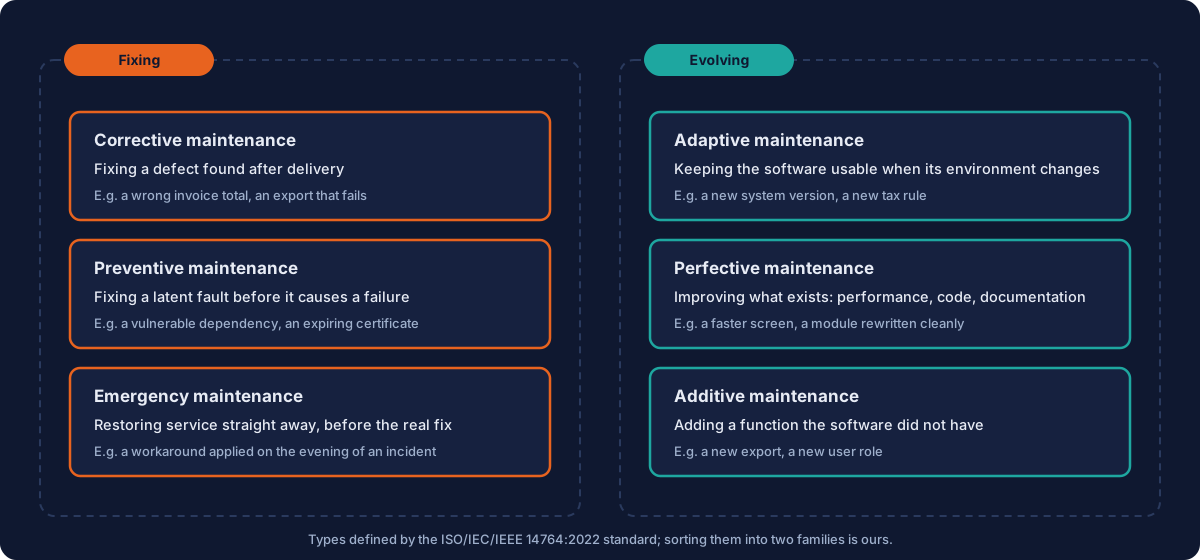
The international standard ISO/IEC/IEEE 14764, devoted to software maintenance, defines six types. French contracts usually keep three or four of them, under the names corrective, preventive, adaptive and evolutionary maintenance. Here is what each one means, with an example.
- Corrective maintenance. Fixing a problem found after delivery: a wrong invoice total, an export that fails, a screen that no longer opens.
- Emergency maintenance. An unscheduled intervention that gets the service running again straight away, pending the real fix. The standard treats it as a type of its own; in a contract, it is the incident procedure.
- Preventive maintenance. Fixing a latent fault before it causes a failure: a dependency with a newly published vulnerability, a certificate about to expire.
- Adaptive maintenance. Keeping the software usable when its environment changes: a new version of the operating system or the database, a new legal obligation. The move to mandatory e-invoicing in France is a recent example.
- Perfective maintenance. Improving what exists without adding anything: a faster screen, a module rewritten more cleanly, documentation brought up to date.
- Additive maintenance. Adding a function the software did not have: a new export, a new user role.
In everyday language, perfective and additive maintenance, and often adaptive maintenance too, are grouped under the name evolutionary maintenance. That is where most misunderstandings live: for the user, "it does not work the way I would like" is a defect; for the provider, it is a change request. The contract has to settle it, with examples.
Maintenance, managed hosting, warranty, MCO: what is the difference? #
These four words turn up in the same quotes, and they do not mean the same thing.
- The warranty covers defects in what has just been delivered, for a limited period and at no extra cost. It covers neither changes nor what shifts around the software.
- Application maintenance takes over on the code: fixes, adaptations, changes.
- Managed hosting, which French quotes call infogérance, deals with operations: servers, monitoring, backups, system patches. Perfectly maintained software on a server nobody watches still goes down in the end.
- MCO, short for maintien en condition opérationnelle, is a broader French term that comes from industry and defence: everything needed to keep a system available, code and machines included.
Some providers sell application maintenance alone, and the application stays hosted elsewhere. Others bring it all together. That is our choice: at Sanfytech, every fixed-price delivery is covered by a three-month warranty; after that, application maintenance is part of the managed hosting contract, along with monitoring, security patches and backups. Both approaches can be defended. What matters is knowing, before you sign, who answers for what when the application stops.
What an application maintenance contract should contain #
A maintenance contract is judged by its precision. Here are the points it should cover, in the order in which they prevent the most disputes.
- The scope. Which applications, which versions, which environments (production, test). What is not written down is not covered.
- The line between a defect and a change. A defect is a gap between what the software does and what it was meant to do, according to a document both parties recognise. Everything else is a change. Without a reference document, every request turns into a negotiation.
- Severity levels and response times. A blocking, major or minor defect does not call for the same response. For each, the contract sets a time to acknowledge and, where possible, a time to restore service. This is what the trade calls a service level agreement, or SLA.
- Service hours. Working days, or on-call cover at night and at weekends: the price is not the same, and neither is the service. Ask what happens to an alert at three in the morning.
- The volume of changes included. A number of days, of tickets, or a budget per period, and what happens to the unused balance.
- Reporting. A regular report: requests received, handled, pending, time spent. Without it, you pay a subscription without knowing what it buys.
- Access and security. Who can reach production and the data, with which accounts, and how that access is withdrawn when the contract ends.
- Ownership of the code and the documentation. The fixes and changes produced during the contract must come back to you, with up-to-date source code. Under French law, a transfer of copyright has to be written down: it is never implied.
- Reversibility. What you get back if you leave, how quickly and in what format: code, documentation, data, access. And the help the outgoing provider owes the next one.
- Term and exit. Commitment period, notice, price review.
Fixed price, tickets or time and materials: how it is billed #
Three billing models dominate, and many contracts combine them.
- Fixed price. A set price per period for a defined scope: corrective maintenance, for instance, whatever the number of defects. The provider carries the risk, and prices it in. Suited to a stable application.
- Tickets or prepaid time. You buy a book of tickets or hours, drawn down with each request. Flexible for a small scope, provided you know what a ticket is worth and how long the credit stays valid.
- Time and materials. You pay for the days actually worked. Suited to a need that keeps changing, but it is up to you to track consumption.
The price depends on the size of the application, its age, the state of its code and documentation, how critical it is and the service hours requested. Be wary of a price quoted before the provider has looked at the code: the gap resurfaces later, one way or another. For our own contracts, price ranges are published on the pricing page.
Taking over software written by someone else: the handover phase #
Maintenance rarely starts the day after the contract is signed. In between comes a familiarisation phase, often called knowledge transfer or onboarding. Three conditions make it possible.
- The right to modify the software. Under French law, a person entitled to use software may carry out the acts needed to use it, including correcting errors; but the author may reserve that right by contract (article L122-6-1 of the French Intellectual Property Code). Before handing your application to a third party, reread the contract signed with whoever wrote it: do you hold the rights to the code, or only a licence to use it?
- The source code and the access. The current code, the one actually running in production, and access to the servers, the domain names and the third-party service accounts. Delivered code and production code sometimes turn out to be two different things.
- An assessment. The new provider reads the code, runs it, and spots what is fragile and what is missing: tests, documentation, backups. The outcome is a report and, if the provider is honest, the list of what it will not commit to maintaining as it stands.
This is how we work when we take over software we did not write: an assessment of the code and the hosting, a readable report, then a takeover for maintenance or a gradual rebuild, screen by screen, without stopping everything. An Access database or an Excel workbook that has become critical is taken over the same way.
Choosing a maintenance provider: ten questions to ask #
- Who will work on my application: the people I am meeting today, or a team I do not know?
- Do you master the technology my software is built on, and can you show me a comparable application you maintain?
- What does the initial assessment contain, and what does it cost?
- How do you tell a defect from a change? Give me three examples taken from my application.
- How quickly do you pick up a blocking defect, and during which hours?
- How do we send you a request, and how do we follow its progress?
- What does the report contain, and how often do we receive it?
- Where are the code and the data hosted, and who has access to them?
- What happens if the person who knows my application leaves your company?
- What do I get back if we part ways, and how quickly?
A serious provider answers these ten questions in writing, without being pressed. For the last one, our answer is public: the client leaves with the source code and its documentation, an export of their data in open formats, and access to the services we administered on their behalf.
When maintenance is no longer enough #
Maintenance extends the life of software; it does not make it eternal. Three signs show it is time to talk: every fix breaks something else, the technology is no longer supported by its vendor, and nobody dares touch certain parts of the code any more. The answer is rarely to rewrite everything at once. A gradual rebuild, module by module, keeps the tool in service while the work is done. If the question arises for you, our guides explain what custom software is and what it costs.
Frequently asked questions about application maintenance #
What is the difference between application maintenance and managed hosting? #
Application maintenance deals with the code: fixes and changes. Managed hosting deals with operations: servers, monitoring, backups, system patches. Both can be entrusted to the same provider or to two different ones; in the second case, the contract must say who is called first when the application stops.
Is a maintenance contract mandatory? #
No, not as such: no law requires a company to sign a maintenance contract. However, the security of personal data, which the GDPR places on whoever processes it, assumes software that is kept up to date. And software nobody fixes only holds up as long as nothing changes around it. The real question is who takes care of it: an in-house team, the author of the software or a third party.
Can you change maintenance provider? #
Yes, if the contract provides for it. That is the purpose of the reversibility clause: it requires the outgoing provider to hand over the code, the documentation, the data and the access, and to answer the next provider's questions for a set period. Check it before you sign, not on the day you want to leave.
How much does application maintenance cost? #
There is no price per square metre. The amount depends on the size and the state of the application, how critical it is, the service hours and the volume of changes included. A provider that has carried out an assessment can commit to a fixed price; without one, a price is only a guess. Our price ranges are on the pricing page.
What does TMA stand for? #
Tierce maintenance applicative, the French term for third-party application maintenance. English-speaking providers usually talk about application maintenance outsourcing or application management services (AMS).
Key takeaways #
Application maintenance outsourcing hands the life of software after delivery to a third party: fixing, adapting, extending. It is judged on five points: a written scope, a clear line between defect and change, response times, regular reporting and a prepared exit. Before taking over existing software, a provider must have read its code; before signing, you must know what you get back when you leave.
At Sanfytech, we write custom software in Strasbourg, we host it in France and we maintain it: a three-month warranty after every fixed-price delivery, then fixes and small changes as they come, by the team that wrote the code. We also take over software written by others, after an assessment.
Software to maintain, or to take over? Tell us about it: who wrote it, where it runs, what worries you. In a first conversation, free of charge, we will tell you what we take over, in what order, and what is better rebuilt.
Sources #
- ISO/IEC/IEEE 14764:2022, Software engineering, software life cycle processes, maintenance: definitions of adaptive, additive, corrective, emergency, perfective and preventive maintenance (clauses 3.1.1 to 3.1.10).
- French Intellectual Property Code, article L122-6-1 (acts needed to use software, error correction, contractual reservation by the author) and article L131-3 (transfer of copyright), on Légifrance, in French.
- General Data Protection Regulation, article 32 (security of processing), on EUR-Lex.
- Sanfytech, general terms of sale: three-month warranty and maintenance.